

Most people in digital marketing will tell you SEO belongs to the big players.
Bigger budgets, dedicated content teams, years of domain authority stacked up, it can genuinely feel like showing up to a Formula 1 grid in your mum’s hatchback. And honestly? That feeling is not entirely wrong. But it is increasingly out of date.
But 2026 is a different story.
Artificial intelligence has fundamentally changed how SEO works, and in doing so, it has quietly levelled the playing field. Small businesses that understand how to use AI tools strategically can now produce content, conduct research, and build authority in ways that would have required a full marketing agency just five years ago.
This article breaks down exactly how that works, what tools you should be using, and how to position your business to rank against bigger competitors without burning through your marketing budget.
How AI Is Changing the Way SEO Works:
A few years ago, SEO was largely a numbers game. You published as many blog posts as possible, stuffed them with keywords, and built backlinks through whatever method you could find. Volume was the primary driver of results.
Google’s algorithms have matured significantly since then. The search engine now places far greater emphasis on:
- Topical depth and expertise over surface-level content.
- User experience signals such as time on page and engagement.
- E-E-A-T — Experience, Expertise, Authoritativeness, and Trustworthiness.
- Search intent alignment over keyword density.
At the same time, AI tools have made it dramatically faster and cheaper to produce well-researched, structured, intent-matched content.
Tools like ChatGPT, Claude, Gemini, Surfer SEO, and Semrush’s AI features can help a solo business owner do the kind of keyword research and content planning that previously required a specialist.
But, and this is the critical part, AI-generated content alone is not enough to rank. Google’s systems are increasingly good at identifying thin, generic AI content that adds no real value.
The businesses winning in 2026 are the ones using AI as a research and drafting assistant, not as a replacement for genuine expertise and perspective.
The best way to think about AI in your workflow is this: it is like having a research assistant who never sleeps, never complains, and has read basically everything on the internet. Useful? Enormously.
But you would not hand that assistant the keys and walk away. The direction, the judgement, the actual knowledge of your trade; that still has to come from you.
Practical Ways Small Businesses Can Use AI Tools for Keyword Research and Content Creation:
Let us get into the practical side. Here is how small business owners are using AI tools effectively in 2026.
#1. AI-Assisted Keyword Research
Ahrefs, Semrush, and Google Keyword Planner; these tools are not going anywhere, and they are still worth using. But they have always had a blind spot: they tell you what people search, not why.
That is where AI has quietly become something genuinely useful.
Feed it a description of your business and your ideal customer, and it can help you map out the full range of questions someone might type into Google at every stage of deciding whether to hire you.
Here is a simple process that works well for small businesses:
- Start with a seed topic related to your service or product.
- Use a tool like ChatGPT or Claude to generate a list of questions your ideal customer might type into Google at different stages of their buying journey, from early research to final decision.
- Run those questions through a keyword tool to check search volume and competition.
- Prioritise keywords with clear commercial intent but lower competition; these are often the ones large brands overlook because they are too niche.
Small businesses actually have an advantage here. A national furniture retailer is not going to target “custom kitchen cabinets perth”; but a local cabinet maker can, and they can probably rank for it within weeks.
#2. Faster, Better Content Creation
Content creation used to be the biggest bottleneck for small businesses. Writing a single high-quality blog post could take an entire day. AI changes that equation significantly.
A practical workflow that small businesses are having success with:
- Use AI to research the topic and generate a detailed outline, including potential subheadings and key points to cover.
- Add your own expertise, real examples from your business, and specific perspectives that only you can offer.
- Use AI to polish the language, improve readability, and check that the piece covers the topic thoroughly.
- Run it through a tool like Surfer SEO or Clearscope to ensure it aligns with what is currently ranking.
When you combine that with your own hands-on knowledge, the stuff only you know from years of actually doing the work, what comes out is content that reads like it was written by someone who genuinely knows their subject.
Because it was. And that is exactly the kind of thing Google keeps getting better at identifying and rewarding.
How to Build Topical Authority Without a Large Budget:
Topical authority gets thrown around a lot in SEO circles, but the concept itself is pretty simple. It just means: does your website actually look like it knows what it is talking about?
Not on one page, not for one keyword, across an entire subject area.
Google has gotten very good at making that judgment. And the way you build it has nothing to do with your budget. It is about having a plan and sticking to it.
Build Topic Clusters, Not Isolated Blog Posts
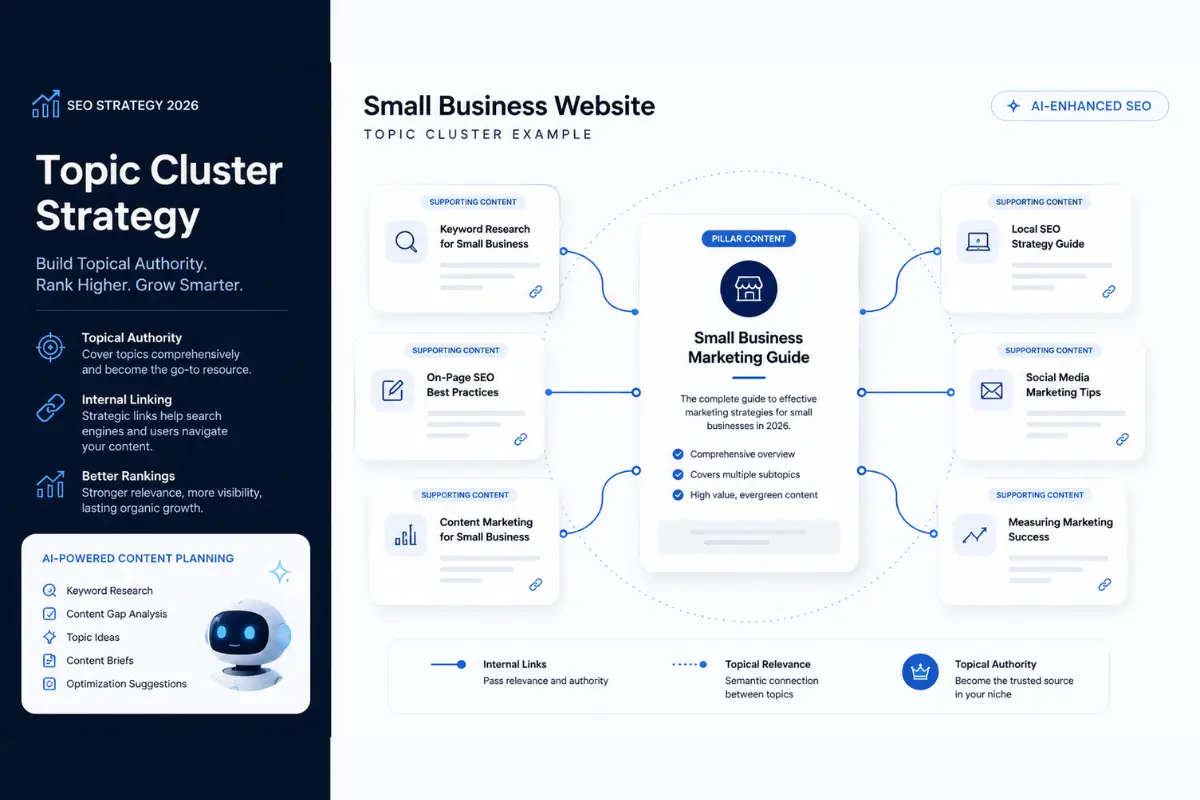
Rather than publishing blog posts on whatever feels relevant that week, the smarter move is to build a connected set of content around the core topics your business actually lives in. One solid, comprehensive page on your main service area, think of it as the hub.
Then a set of supporting pages, each one going deep on a specific question or subtopic, all linking back to that central piece.
Done consistently over a few months, this structure tells Google something important: this site does not just mention this topic, it genuinely covers it.
It is a principle that holds well beyond B2B contexts, too. The team at B2B SEO Company’s content marketing service highlights that the most effective B2B content strategies are built around intent-driven topic clusters rather than scattered publishing, a principle that translates just as well to local and small business SEO contexts.
Focus on “People Also Ask” and Long-Tail Searches:
Long-tail keywords, longer, more specific search phrases, are where small businesses can genuinely outrank large competitors. Big brands tend to focus on high-volume, competitive terms. They often leave the more specific, intent-rich searches wide open.
Use Google’s “People Also Ask” boxes, AnswerThePublic, and AlsoAsked.com to identify the exact questions your potential customers are typing into search. These often reveal opportunities that traditional keyword research misses.
Each of these questions is a content opportunity. Answer it thoroughly, honestly, and with practical detail, and you will consistently outperform generic, brand-heavy content.
Leverage Local SEO as a Force Multiplier:
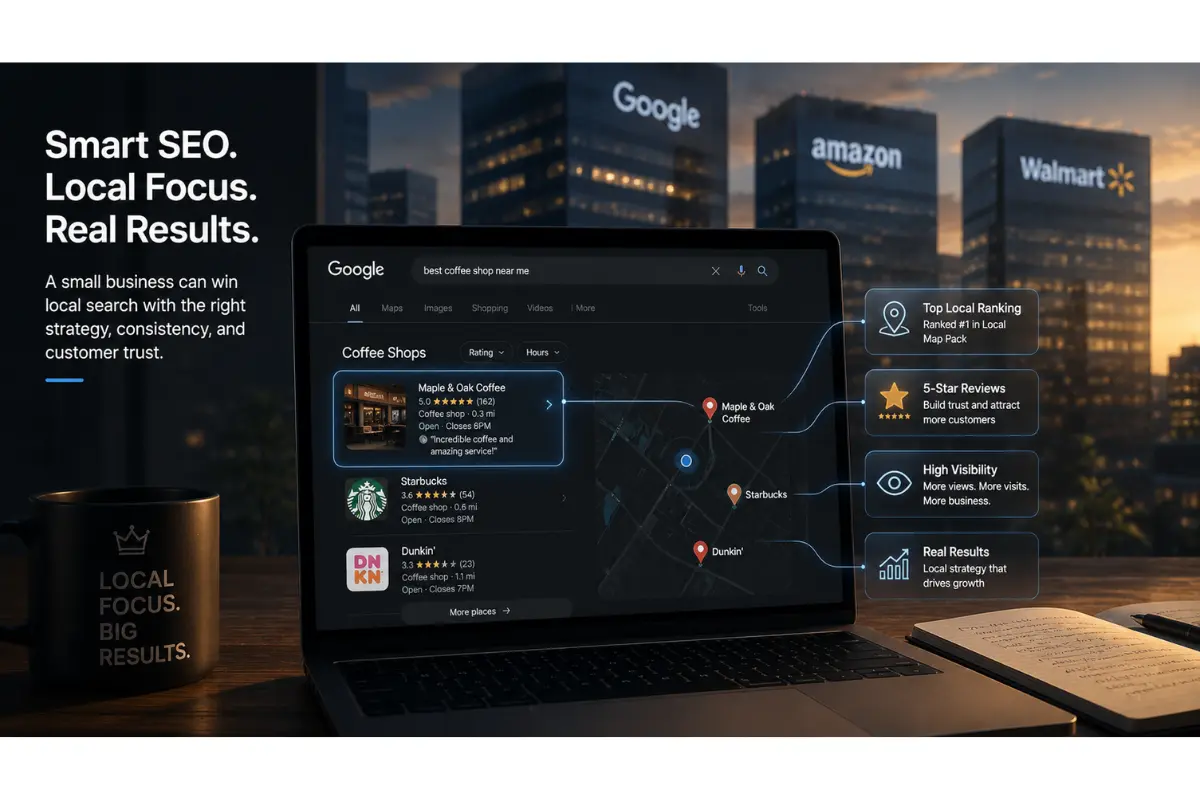
If your business serves a specific town, suburb, or region, local SEO is honestly where you should be spending most of your energy. No national brand can out-local you. They simply cannot.
A well-kept Google Business Profile, pages on your site that actually mention the areas you work in, your name and phone number listed consistently across directories, and a steady flow of real customer reviews. These things compound quietly over time, and they are genuinely hard for a big brand to replicate at street level.
AI can help with the review side of things, too, drafting response templates, flagging new reviews, and reminding you to follow up with recent customers. Small effort, real impact.
Actionable Tips to Compete with Bigger Brands in Search Results:
Right, let’s get into the practical stuff — the things you can actually do this week, not just think about.
#a. Audit Your Existing Content First
Before you write a single new word, go and look at what you already have. Google Search Console is free and shows which of your pages are already appearing in search results but not getting clicked.
Those pages are not lost causes; they just need some attention. A sharper title here, a more useful meta description there, maybe a proper update to the content itself.
In many cases, refreshing an existing page gets faster results than publishing something brand new. Start there.
#b. Win the SERP Features Big Brands Miss
Featured snippets, FAQ sections, and “People Also Ask” boxes appear above regular search results, and they do not always go to the biggest brand.
They go to the page that best answers the question.
Structure your content with clear subheadings, concise paragraph answers, and properly formatted FAQ sections using schema markup. This alone can put a small business website above Fortune 500 companies in search results.
#c. Publish Content That Large Brands Cannot Write
Your greatest competitive advantage is lived experience. You have worked with real clients, solved real problems, and learned things that a content team in a corporate office simply does not know.
Write about those things. Share your process, your mistakes, your specific techniques.
Case studies from your own work, behind-the-scenes process posts, honest comparison articles, and detailed how-to guides based on real experience all perform exceptionally well in search, and they are impossible for bigger brands to replicate authentically.
#d. Use AI to Maintain Consistency at Scale
The biggest SEO problem most small business owners face is not the lack of knowledge or ideas; it is time. You are running a business. You are dealing with customers, suppliers, invoices, and everything else.
Sitting down to write a blog post is the first thing that gets pushed to next week, then next month, then never.
AI does not solve the problem entirely, but it changes the equation. Use it to batch out rough drafts for a month’s worth of content in one sitting. Then spread the editing and publishing across the weeks. It is not glamorous, but it works.
Consistent publishing, even just twice a month, builds more authority over time than ten articles in January and nothing until June.
#e. Build Authority Through Strategic Link Earning
You do not need a backlink from every website on the internet. You need a handful of websites that your actual customers and your industry actually respect.
Guest posts on blogs your audience reads, listings in the directories people in your trade actually use, a piece of original research or local data that a journalist might reference, these are worth far more than bulk link-building schemes.
And do not overlook the obvious ones: if you work alongside complementary businesses, a photographer who often works with florists, a mortgage broker who knows a dozen real estate agents — those are natural linking relationships just waiting to happen.
#f. Invest in Technical SEO Fundamentals
You do not need to hire a developer for this. Run your site through Google Search Console and PageSpeed Insights- both free- and just deal with whatever comes up.
Slow loading on mobile, broken links, missing headings, and no HTTPS; these issues affect every single page on your site, and a lot of small business websites are carrying them quietly in the background.
Fixing them is not exciting work, but it often produces ranking improvements faster than any new content would.
The Mindset Shift That Changes Everything:
The most important thing to understand about competing with big brands in SEO is that you are not trying to beat big brands everywhere. You are trying to beat them in the specific places where your customers are actually searching.
Large companies chase volume. They want the broad keywords, the big traffic numbers, the campaigns that scale across every market at once.
What they are not doing, what they genuinely cannot do well, is producing content that is specific, local, and grounded in the day-to-day reality of a particular trade or community.
That is your territory. And AI gives you the tools to map it, cover it, and hold it more efficiently than was ever possible before.
The 200-search-a-month keyword where everyone who finds you is ready to buy? That is worth more than a top-ten ranking for a term that pulls in thousands of people who were never going to become customers anyway.
Pick your corners and own them properly.
Final Thoughts:
SEO in 2026 does not automatically favour the biggest budget in the room. It favours whoever can demonstrate the most genuine, useful expertise on a topic — and that is a competition a well-run small business can absolutely show up to.
The tools are accessible, the strategy is learnable, and the gap that once separated small operators from enterprise brands has narrowed considerably.
What fills the remaining gap is consistency, real knowledge, and the kind of specific human insight that no corporate content team can manufacture at scale. That is yours already. Use it.